Why I read it
This book was on my list for a long time. After building small toy parsers, I wanted to go all the way — understand what actually happens between source text and execution.
Structure
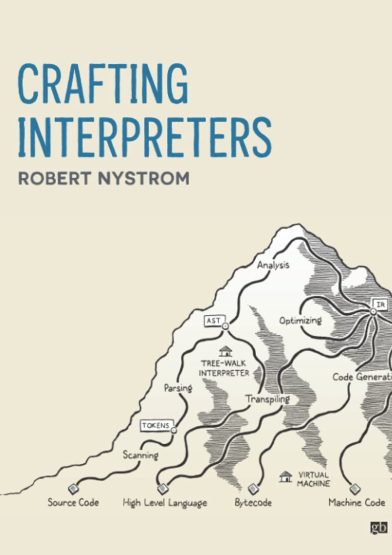
The book is split into two parts:
- jlox — a tree-walk interpreter written in Java, focused on understanding the concepts clearly
- clox — a bytecode VM written in C, optimized and closer to how real runtimes work
Each chapter builds something real. You’re never just reading theory.
Key ideas I kept
- Scanning is simpler than it looks once you think of it as a state machine
- Recursive descent parsing is elegant and readable — matching grammar rules to functions
- The environment model for variable scoping made closures finally click for me
- Bytecode compilation makes the jump from tree-walking feel natural, not magical
What it changed
After this book I started understanding C code differently. The clox VM chapters — managing memory manually, writing a mark-and-sweep GC from scratch — demystified a lot of low-level C patterns I’d seen but never fully understood.
Notes & Chapters
- Chapter 4 — Scanning
- Chapter 6 — Parsing Expressions
- Chapter 10 — Functions
- Chapter 19 — Bytecode Virtual Machine
- Chapter 26 — Garbage Collection
(Add your chapter notes as separate posts and link them here)